



“This magazine is full of voices the world refuses to listen to. I had the honor of reading each and every submission, witnessing young people pour their souls onto these pages.” – Brit Christopher
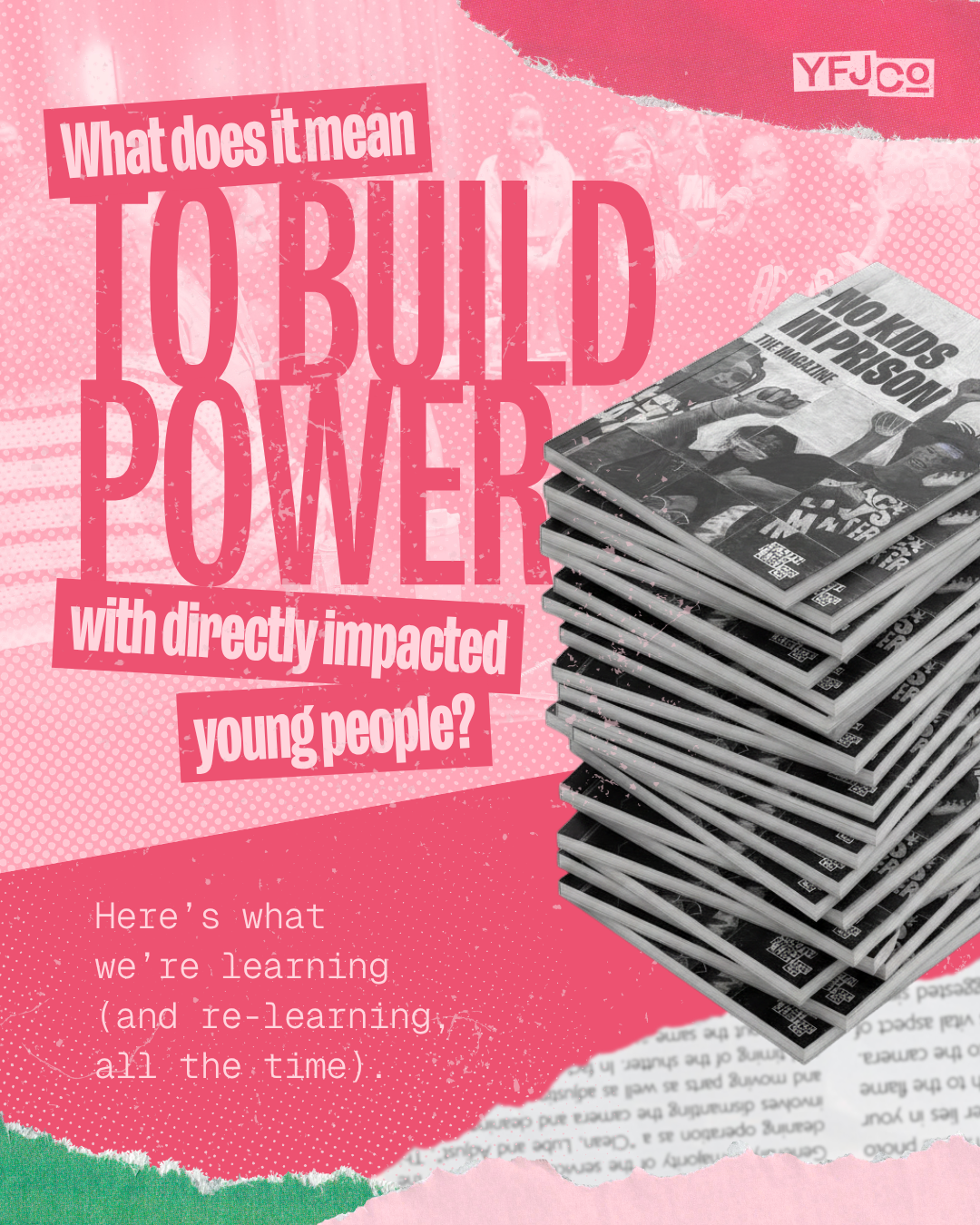
We launched the No Kids In Prison magazine this month after more than a year of intentional planning, curating, editing and publishing, led by two brilliant youth curatorial apprentices. The magazine makes clear that young people impacted by the prison system are the best narrators of their own stories and the best architects of their own futures.
We work every day to build power alongside a growing network of dedicated and resilient young people who have bold and visionary ideas about the future we can build together. If we divest from youth incarceration and build strong, life-affirming communities that provide care and support to young people, we can radically transform their lives.
For decades, the youth justice movement has organized in communities hard-hit by mass incarceration, family policing, the school-to-prison pipeline and an appalling lack of investment in healthcare, employment and housing. We’ve built real political power to keep kids out of prison, shut down lock-up facilities and promote community-based alternatives to incarceration.
Despite all this progress, the tide is turning against us. The rise of authoritarianism and increasingly punitive political headwinds threaten to dismantle our successes, one by one.
Community organizing and basebuilding are the foundations of our success, but they are no longer enough to sustain long-term progress. We need to build narrative power, to fundamentally change the national conversation about youth justice. We need to ensure that when we connect with people in communities, we are telling stories of a future that’s worth fighting for, an aspirational narrative that can re-wire our collective thinking about justice.
Narrative is a powerful tool for movement building.
Organizers need narratives, stories and lived experiences brought into the public sphere to help people connect the facts to real human impact. Facts alone rarely move people. Narrative strategy helps create the conditions for people to understand systemic issues differently and to see impacted communities with empathy and dignity, rather than through fear-based stereotypes.
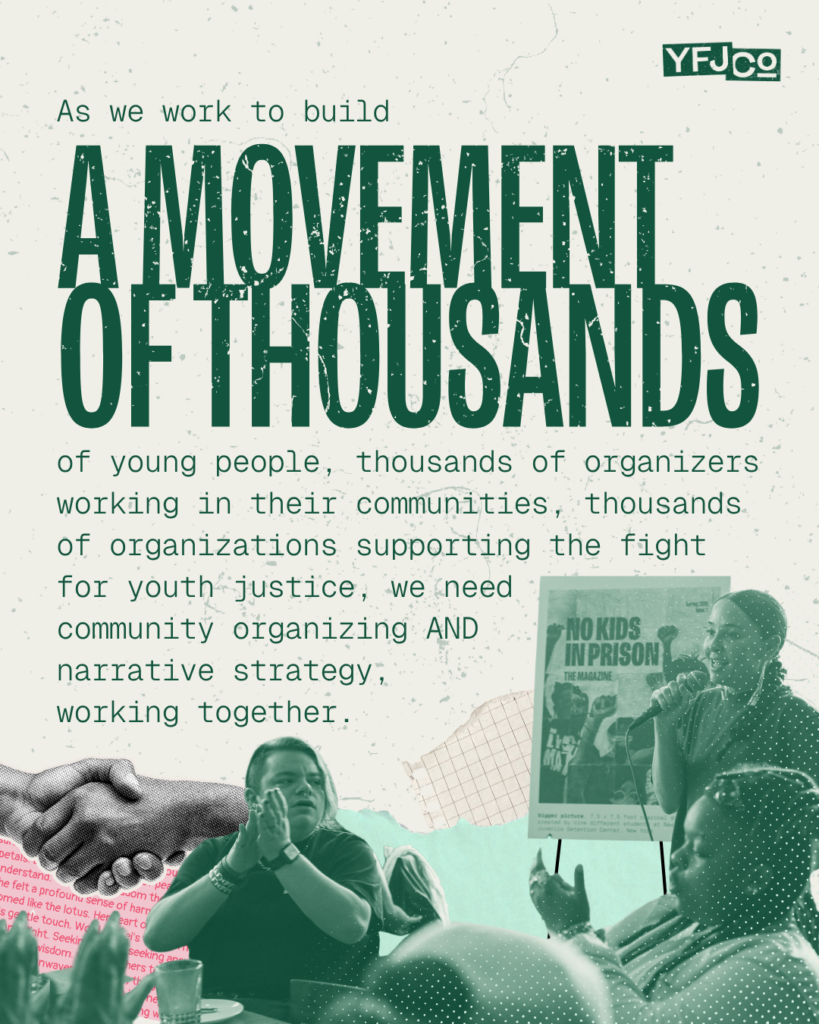
Organizing and narrative work have to move together–one builds people power on the ground, while the other helps shift public consciousness and expand what people believe is possible.
Young people especially understand that organizing happens both on the ground and in the cultural sphere. They are thinking strategically about social media, storytelling, art, digital culture and political education as tools for shifting consciousness and building solidarity.
Building narrative power is the next frontier of this movement. We are currently living the reality that traditional policy and advocacy approaches can only do so much within a system that wasn’t built for us, doesn’t truly represent us and doesn’t work to secure basic needs for children and families.
We have to fundamentally change the conversation and amplify a new story, where justice, fairness and compassion triumph over punishment and control.
We see three opportunities for narrative strategy to bring people into this movement and mobilize them to take action:
- Narrative strategy helps people imagine a different world and a different way of living. Relying on facts and data only gives people context for the world as it is. Unlocking the power of imagination gives people the ability to see the possibilities of what could be, where different decisions could lead us if we followed our values. We don’t have to rely only on imagination, though–we have countless examples of innovative, new and successful programs that affirm young people’s humanity and capacity for change, while addressing root causes of poverty, violence and crisis.
- Narratives are about all of us. They make the people we’re talking to characters in the story of liberation. People are prone to compassion fatigue, so we have to make problems both solvable and relevant if we want them to take action. If problems seem intractable, people give up. If it seems like someone else’s problem to solve, they hold back. We have to be constantly answering the question, “But what can I do about it?” with specific, concrete and aspirational ways to bring people into the movement.
- Narratives not only help people understand issues better, but they create meaning, an essential component of activism. Why does compassion and support for young people matter? What does it look like? When we connect to people’s values (a crucial part of their identity), we have an opening to not just change their mind, but to change their heart. It makes the issues we work on not just urgent, but human. When we care about the people in the story, we’ll show up for them and fight alongside them.
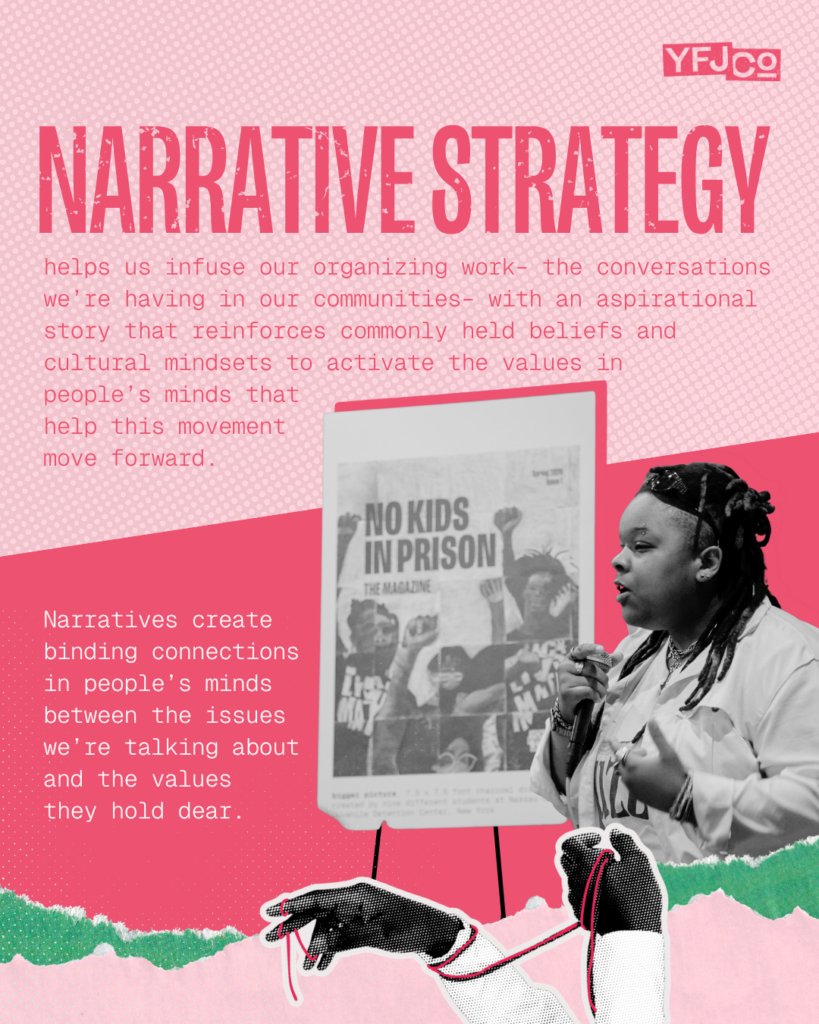
Narrative power is the ability to shape how people understand the world, what they believe is possible, and who they believe deserves safety, dignity and opportunity. Narrative power shapes public opinion, culture, policy and people’s everyday experiences. It is about more than messaging or communications, it is about challenging harmful stories and replacing them with stories rooted in justice, community and shared humanity.
Building narrative power is not just about the stories we tell, it’s also about who is telling them, where and how.
Today’s information and media landscape is complex, crowded, and inaccessible to many of us. It is designed to benefit the wealthy and powerful, not the people.
Building narrative power means creating conditions for people and communities impacted by youth incarceration to tell their own stories and define their own realities, instead of being defined by politicians, media, or powerful institutions.
That’s why we have to build our own narrative infrastructure, an ecosystem of storytelling that exists outside of a status quo that upholds racial capitalism. The No Kids In Prison magazine was an important learning model for how to do that in a way that felt true to this movement.
When the magazine was in its very early planning stages, we had many conversations internally, with our network and with youth leaders about:
- How to create a platform where young people directly impacted by incarceration can tell their own stories in their own voices?
- How to move beyond narratives that reduce young people to statistics, trauma or criminalization?
- How can a magazine become more than a publication? How can it become a tool for political education, culture shift and movement building?
We also wrestled with important challenges. We knew we did not want to reproduce extractive storytelling or tokenize young people’s experiences. We wanted the process itself to reflect our values by being youth-led, collaborative and grounded in care, creativity and political analysis. We also discussed how to make the magazine accessible and compelling to audiences beyond the movement, so it could help shift public understanding around youth incarceration and who deserves safety, healing and opportunity.
We solicited submissions from currently and formerly incarcerated youth. Two apprentices – Brit Christopher of Care Not Control PA and Gabriel Arika of Legal Rights Center in MN – led curation and content planning. Youth-led distribution teams are hitting the streets to get the magazine out into the community.
“The magazine helps connect people who come from different walks of the same path. Sharing their stories with people who care, who understand, whose own story might sound similar, helps young people heal. But it also builds a network of people saying, ‘We got you’ – politically, culturally and materially. That’s a very powerful thing.” – Brit Christopher
We’ve learned that we are most powerful when we go back to basics. Hitting the street, knocking on doors, meeting people face-to-face and building real, trusting relationships over time is how we build power outside the mainstream infrastructure that benefits only a powerful few.
“Young people, especially those who have been historically discounted, deserve grace and a chance to be heard about issues that affect them. I believe that most people want to see youth do well, but they haven’t been offered a new way of thinking about what that requires. We need investment in communities – housing, healthcare, education, infrastructure, youth programs and third spaces to nurture young people and give them tools to build their futures.” – Gabriel Arika
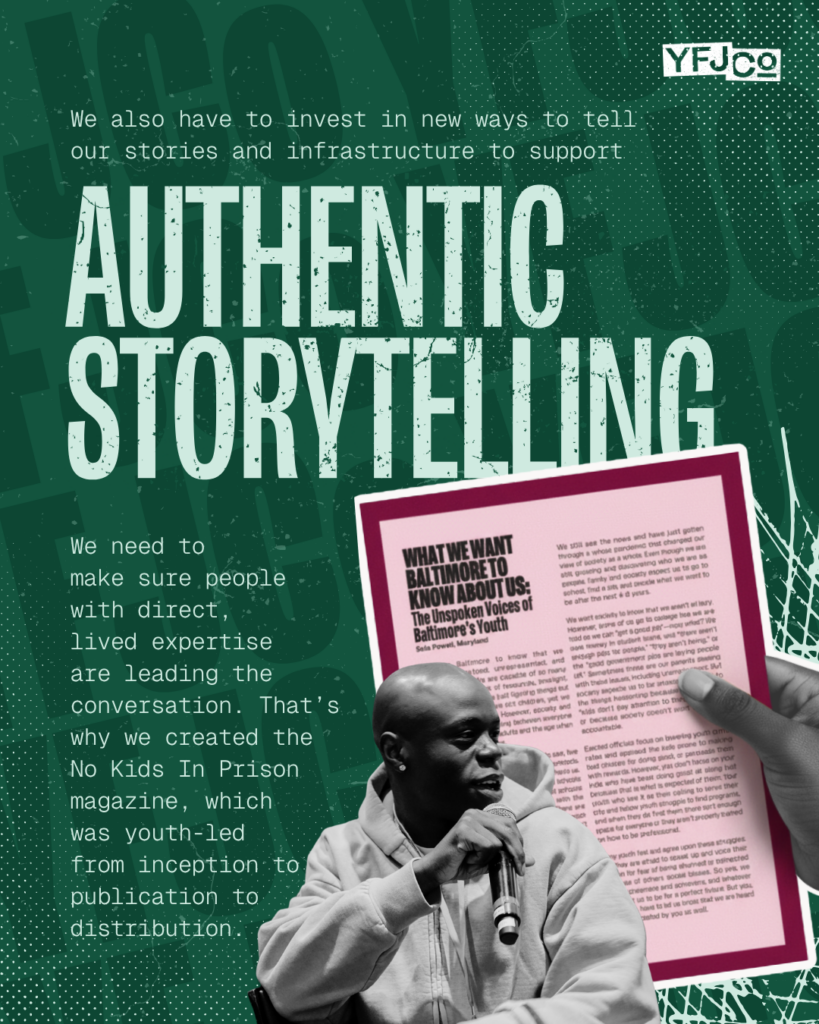
The magazine is giving youth leaders an opportunity to start those conversations in their own communities. It’s a tangible work of art that people can hold in their hands and pass along to their neighbors. It’s an act of resistance, as society overlooks the way we treat young people who are still growing into their accountability.
But telling their own stories, even about their mistakes, is a powerful act of reclaiming their futures.
When we invest in young people’s creativity and leadership, they show up and show out. They know what they need to thrive, they know what communities need to create security and safety for all and, unfortunately, they know all the ways youth prisons fail.
We only need to listen.